Call for Papers: Carceral Geography at the Association of American Geographers conference, Chicago, 2015

Papers are invited, on diverse aspects of carceral geography, for the Association of American Geographers annual conference, to be held in Chicago in April 2015

Session organisers: Jennifer Turner (University of Leicester), Marie Hutton (University of Birmingham), and Dominique Moran (University of Birmingham)

Although prisons and criminal justice systems are integral parts of governance and techniques of governmentality, the geographical study of the prison and other confined or closed spaces is still relatively novel. The vibrant subdiscipline of carceral geography has already made substantial progress, has established useful and fruitful dialogues with cognate disciplines of criminology and prison sociology, and is attuned to issues of contemporary import such as hyperincarceration and the advance of the punitive state. It has also used the carceral context as a lens through which to view concepts with wider currency within contemporary and critical human geography. Thus far, it has made key contributions to debates within human geography over mobility, liminality, and embodiment, and it has increasingly found a wider audience, with geographical approaches to carceral space being taken up by and developed further within criminology and prison sociology. Carceral geography brings to the study of prisons and imprisonment an understanding of relational space, as encountered, performed and fluid. Rather than seeing prisons as spatially fixed and bounded containers for people and imprisonment practices, rolled out across Cartesian space through prison systems straightforwardly mappable in scale and distance, carceral geography has tended towards an interpretation of prisons as fluid, geographically-anchored sites of connections and relations, both connected to each other and articulated with wider social processes through and via mobile and embodied practices. Hence its focus on the experience, performance and mutability of prison space, the porous prison boundary, mobility within and between institutions, and the ways in which meanings and significations are manifest within fluid and ever-becoming carceral landscapes.

This session both invites contributions which reflect the development of carceral geography to date, and also those which suggest future developments – these could explore:
• the emergent discourse of criminological cartography;
• transdisciplinary synergies between carceral geography, law, psychology, and architectural studies;
• prison design and the lived experience of carceral spaces;
• affect and emotion;
• carceral TimeSpace;
• the embodied experience of incarceration;
• feminist and corporeal carceral geographies;
• theorisation of coerced, governmental or disciplined mobility;
• confluence with critical border studies;
• dialogue with architectural and cultural geographies;
• engagement with abolitionist praxis;
• notions of the purposes of imprisonment and the geographical and/or historical contexts in which these are socially constructed.

Submissions:
Please submit abstracts of no more than 250 words by email to Jennifer Turner (jt264@le.ac.uk) and Marie Hutton (m.a.hutton@bham.ac.uk) by 1st October 2014.

Successful submissions will be contacted by 8th October 2014 and will be expected to register and submit their abstracts online at the AAG website by October 31st 2014 ahead of a session proposal deadline of 5th November 2014. Please note a range of registration fees will apply and must be paid before the submission of abstracts to the AAG online system.

‘Carceral Spaces’ reviewed in Antipode

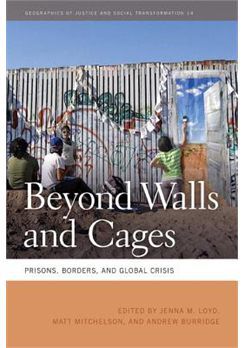
moran_gen 55 cover.QXD_mobility and agencyA review of our recent book ‘Carceral Spaces: Mobility and Agency in Imprisonment and Migrant Detention’ (Ashgate 2013) has just been published in radical geography journal ‘Antipode’. Jill Williams reviews the book alongside ‘Beyond Walls and Cages’, edited by our colleagues Jenna Loyd, Matt Mitchelson and Andrew Burridge.

Jill Williams’ review highlights the differences between the two volumes, but notes that both make ‘important contributions to the existing critical geographic scholarship on imprisonment and migrant detention’. Read the full review here.

Post-Doctoral Opportunities: Immigrant Detention, Prisons and Mobility

There are two Post-Doctoral Fellowships available at the Centre for Criminology, University of Oxford. Details are:

Post-Doctoral Research Fellowship, “Home and away: Gender, nation, deportation.” [Grade 7: £29,249-£35,938, fixed term for 42 months]

The Centre for Criminology is looking to appoint a suitably qualified person to a full-time Post-Doctoral Research Fellowship entitled “Home and away: Gender, nation, deportation” for a fixed period of 42 months.  The fellow will carry out a program of original research into the experiences of immigration detention in Britain and return.  The person appointed will have research expertise in a relevant field and an academic publishing record commensurate with stage of career. They will publish academic articles and a monograph, participating in the wider ERC funded-research project, led by Dr Mary Bosworth, of which this is part, organising conferences and an edited collection.

Post-Doctoral Research Fellowship, “The postcolonial prison: citizenship, punishment and mobility.” [Grade 7: £29,249-£35,938, fixed term for 42 months]

The Centre for Criminology is looking to appoint a suitably qualified person to a full-time Post-Doctoral Research Fellowship on “The postcolonial prison: citizenship, punishment and mobility” for a fixed period of 42 months. The fellow will carry out a program of original research on foreign national prisoners in England and Wales and another European country. She/he will have research expertise in a relevant field and an academic publishing record commensurate with stage of career. She/he will publish academic articles and a monograph, and participate in the wider ERC funded-research project of which this is part, led by Dr Mary Bosworth.

Although the parameters of the studies are described here in brief, these are designed as independent pieces of research to be lead by the applicant.

In all cases, only applications received before midday on Friday November 23 can be considered. Applications are to be made online. To apply, please visit www.ox.ac.uk and search for the relevant vacancy in the jobs section.

Carceral Geography – new books!

What’s that saying? You wait forever for a bus and then three come along at once? Well, this is not quite all at once, but the great news is that there are four new forthcoming books which should be of interest to geographers and others working on spaces and practices of incarceration.

Further details are available on all of these books through the links above, but some brief information is below:

“Border Watch: Cultures of Immigration, Detention and Control”

Alexandra Hall 2012

Questions over immigration and asylum face almost all Western countries. Should only economically useful immigrants be allowed? What should be done with unwanted or ‘illegal’ immigrants? In this bold and original intervention, Alexandra Hall shows that immigration detention centres offer a window onto society’s broader attitudes towards immigrants.

Beyond Walls and Cages: Prisons, Borders and Global Crisis”

Jenna Loyd, Matt Mitchelson, Andrew Burridge [Eds] 2012

The crisis of borders and prisons can be seen starkly in statistics. In 2011 some 1,500 migrants died trying to enter Europe, and the United States deported nearly 400,000 and imprisoned some 2.3 million people—more than at any other time in history. International borders are increasingly militarized places embedded within domestic policing and imprisonment and entwined with expanding prison-industrial complexes. Beyond Walls and Cages offers scholarly and activist perspectives on these issues and explores how the international community can move toward a more humane future. Working at a range of geographic scales and locations, contributors examine concrete and ideological connections among prisons, migration policing and detention, border fortification, and militarization. They challenge the idea that prisons and borders create safety, security, and order, showing that they can be forms of coercive mobility that separate loved ones, disempower communities, and increase shared harms of poverty. Walls and cages can also fortify wealth and power inequalities, racism, and gender and sexual oppression. See the related blog here.

“Carceral Spaces: Mobility and Agency in Imprisonment and Migrant Detention”

Dominique Moran, Nick Gill & Deirdre Conlon [Eds] 2013

This book draws together the work of a new community of scholars with a growing interest in carceral geography: the geographical study of practices of imprisonment and detention. It combines work by geographers in ‘mainstream’ penal establishments that incarcerate people convicted of a crime by the prevailing legal system, with geographers’ recent work on migrant detention centres, in which refused asylum seekers, irregular migrants and some others are detained, ostensibly pending decisions on admittance or repatriation. In each of these contexts, contributions investigate the geographical location and spatialities of institutions, the nature of spaces of incarceration and detention and experiences inside them, governmentality and prisoner agency, cultural geographies of penal spaces, and mobility in the carceral context. In dialogue with emergent and topical agendas in geography around mobility, space and agency, and in relation to international policy challenges such as the (dis)functionality of imprisonment, and the search for alternatives to detention, the book draws upon and speaks back to geography, criminology and prison sociology.

Look out for this one early in 2013 – more details to come.

“Carceral Geography: Prisons, Power and Space”

Dominique Moran 2013

The so-called ‘punitive turn’ has brought about new ways of thinking about geography and the state, and has highlighted spaces of incarceration as a new terrain for exploration by geographers. This book introduces ‘carceral geography’ as a geographical perspective on incarceration, tracking the ideas, practices and engagements that have shaped the development of this new and vibrant sub-discipline, and suggesting future research directions which are dynamically open to transdisciplinarity, which are both informed by and extend theoretical developments in geography, but which also, and critically, interface with contemporary debates over hyperincarceration, recidivism and the advance of the punitive state. This book conveys a sense of the debates, directions, and threads within the field of carceral geography, tracing the inner workings of this dynamic field, its synergies with criminology and prison sociology, and its likely future trajectories. By synthesizing existing work in carceral geography, and by exploring the future directions it might take, the book develops a notion of the ‘carceral’ as spatial, emplaced, mobile, embodied and affective.

More details to come as this one progresses…

Geographies of Justice RGS-IBG pre-conference 2/7/2012

For anyone attending the RGS-IBG conference in Edinburgh this July, please note that there is a pre RGS-IBG conference event sponsored by the RGS-IBG & Space and Society Research Group, held at the School of Environment, University of Dundee, which is approximately an hour from Edinburgh

Geographies of Justice RGS-IBG pre-conference

2nd July 2012 10.15 – 17.30

Events include:

  • Opening lecture
  • Spaces of Justice Research
  • Giving Voice in Justice Research
  • ‘New Directions’ expert panel discussion

Keynote Speakers include:

  • Dr Elizabeth Olson (University of North Carolina at Chapel Hill, USA)
  • Prof Rachel Pain (Durham University, UK)
  • Prof Sue Parnell (University of Cape Town, South Africa)
  • Prof Gordon Walker (Lancaster University, UK)

The event is free to attend but places are limited.

To book a place please email Dr Lorraine van Blerk (l.c.vanblerk@dundee.ac.uk) by 1st June 2012.

Faith in Carceral Space

In her recent paper in Political Geography, JoAnn McGregor argues that removal centres for detained immigrants in the UK are acting as spaces of religious revival. By exploring why confinement for removal fosters enhanced religious engagement, her paper examines experiences of detention and deportability based on ex-detainees’ accounts, investigates institutional provision, and detainees’ own initiatives regarding faith, and treats faith in its affective, emotional, narrative and performative dimensions. McGregor finds that faith acts as as a source of resilience for non-citizens faced with legal exclusion.

McGregor’s work is amongst the first within geography to explore the importance of faith during confinement. However, in cognate disciplines there are intriguing glimpses of the role that faith plays within and beyond carceral space. For example, Revd. Peter Phillips, a mature PhD student at the University of Cardiff, UK, is working on the role of prison chaplains ‘caught in no-man’s land’ as both agents of the prison establishment and/or as counter-agents within it.  In so doing, he works with theories of liminality to explore participation in ritual-like activities, affiliation/disaffiliation, and the importance of prison chaplaincy in prison ethnography, focusing particularly on prison chapels and reception areas. Within criminology, Grant Duwe and Valerie Clark find in their study of prison visitation and recidivism in Minnesota US, that visits from clergy lowered the risk of prisoners reoffending after release by 24%. They suggest that the training that clergy often receive in helping individuals through difficult life circumstances, may mean that they are able to give offenders the kind of effective counsel and support that they need. Their study contributes to a growing body of work considering the effectiveness of faith-based rehabilitation programmes during incarceration (e.g. Dodson et al 2011), and the role of faith in facilitating ‘reintegration’ after release (such as Kerley et al’s 2011 study of a faith-based transitional centre for women in the Southern United States).

Within carceral space, recent geographical research in Russian prisons suggests that in constructing prison chapels, the Russian Orthodox Church provides spaces of retreat and escape from the oppressively communal prison environment. Women interviewed for a recently completed research project suggested that not only were chapels used as spaces for devout prayer, and for recreation in the form of choral singing, but that they also provided a rare sense of solitude and privacy within prison walls, where prisoners retreated into the privacy of the self.

McGregor’s work highlights the potential for faith to act as a “‘coping mechanism’” to help detainees “through distressing periods in detention” (2012, 243). By drawing attention to the complex role of faith in the lives of the detained (and those released after detention), though, her work points to ways in which carceral geography, along with cognate disciplines, can nuance understandings of faith in carceral space, perhaps to problematise what might be understood by the  ‘effectiveness’ of faith-based interventions.

Are you working on faith in carceral space? Let us know about your work by posting a comment below: